
How Teneo IoT Uses Datacake and LoRaWAN to Scale Smart Monitoring Across Agriculture, Industry, and Cities
From monitoring animal-feed levels in agricultural silos to optimizing waste collection, automating tree irrigation, and managing energy consumption, Teneo IoT combines its sensor technology with Datacake to turn real-world data into smarter decisions and automated actions.
One IoT Partnership, Many Real-World Applications
Founded in the Netherlands in 2016 by Inou Heideman and Erik Prange, Teneo IoT develops accessible IoT solutions for applications ranging from agriculture and industry to smart cities and infrastructure.
Over the years, Teneo and Datacake have collaborated on multiple IoT implementations, including the Safe Harbour project, where Datacake's API and backend supported smart campsite pitch availability and electricity management.
Today, that collaboration continues across new applications, with Teneo's sensors collecting data in the field and Datacake providing the infrastructure to visualize, manage, report, and act on it.
One of Teneo's latest deployments shows just how tangible the business value of IoT can be.
IoT Silo Monitoring: Solving an Expensive Logistics Problem
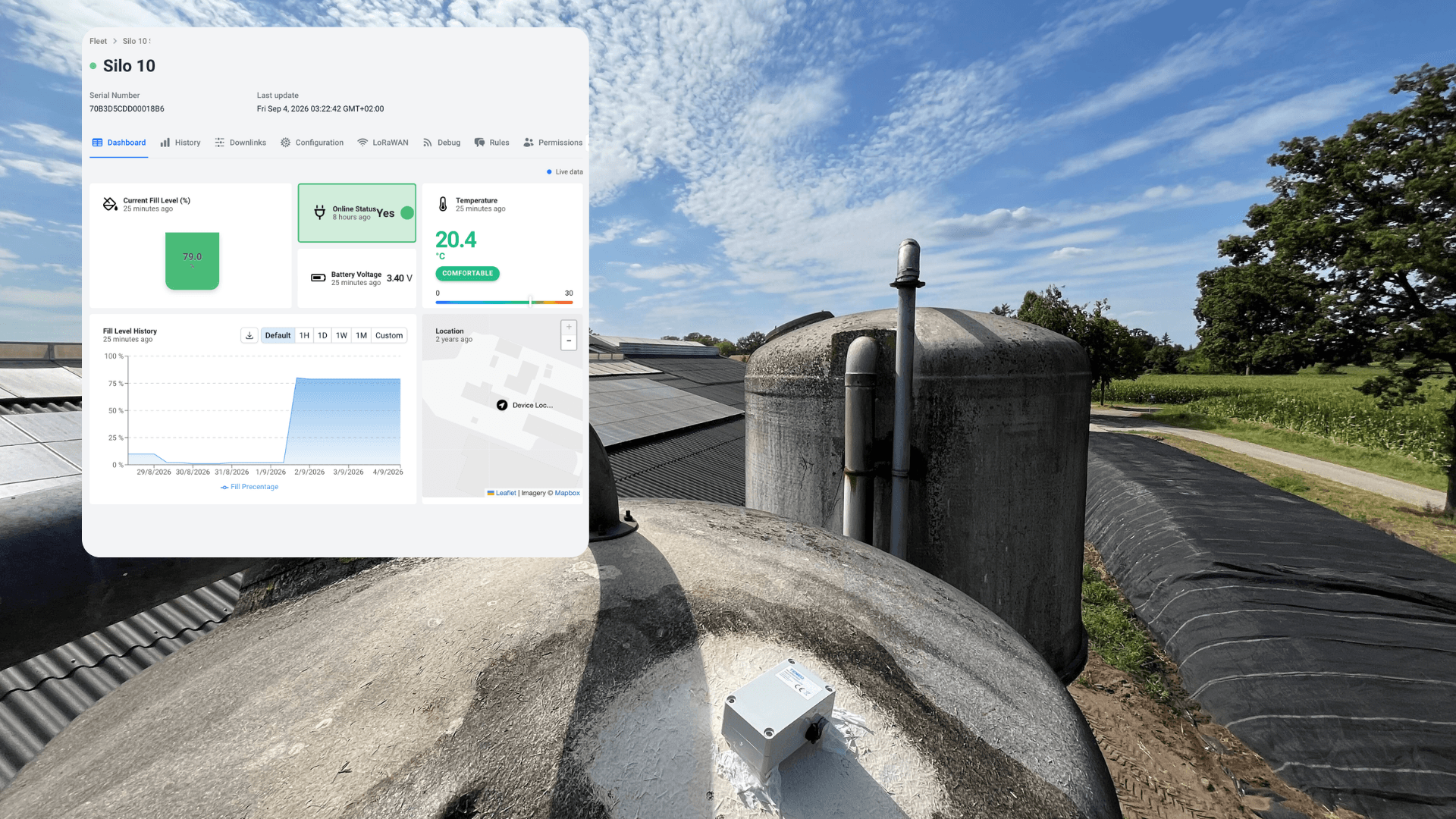
One of Teneo's current projects involves monitoring silos containing feed for cows and goats.
For animal-feed suppliers, knowing exactly when a silo needs to be refilled is more important than it might initially seem.
Without sensors, farmers have to manually check their silos. Depending on the silo and conditions, that can mean visually estimating the fill level or even using a long stick to determine how much feed remains.
The problem arises when the silo becomes empty sooner than expected.
Feed cannot simply wait until the next scheduled delivery when livestock depend on it. A supplier may need to arrange a last-minute trip with a large truck specifically for one customer.
According to Teneo, the customer behind this project previously faced more than €1 million in costs per year associated with last-minute deliveries.
That's where continuous IoT fill-level monitoring changes the equation.
Teneo's sensors provide continuous visibility into how much feed remains inside each customer's silo. When levels begin to run low, the feed provider can proactively contact the farmer and coordinate the next delivery before the situation becomes urgent. At the same time, Datacake's Rule Engine automatically sends an email notification to the farmer, keeping them informed about their feed levels.
This helps both parties plan ahead, reduces the need for costly last-minute deliveries, and gives farmers greater peace of mind.
Could Preventing Just 10% of Emergency Deliveries Pay for the IoT Solution?
Teneo previously calculated the business case based on factors including sensor costs, connectivity, and monthly operating expenses.
The result was particularly interesting: according to Inou Heideman, reducing last-minute deliveries by approximately 10% could already be enough for the monitoring solution to reach break-even.
Every additional efficiency gained beyond that point strengthens the business case.
But there is another benefit that is harder to quantify: peace of mind.
Instead of farmers repeatedly checking silo levels and suppliers reacting to unexpected shortages, both sides gain continuous visibility into the process.
Scaling from Existing Devices to 170 New Sensors on Datacake
The project is now entering a new phase.
The customer is continuing to build on its existing IoT monitoring setup and is now expanding the deployment while integrating it into Datacake.
As part of that expansion, Teneo is installing 170 new sensors on Datacake.
Teneo handles the process from the field to the platform: supplying and installing the sensors, onboarding the devices, configuring locations and device information, and creating the Datacake dashboards used by the customer.
Datacake's device templates also help simplify scaling. Once a device has been configured as required, Teneo can use the existing configuration as the basis for additional devices instead of rebuilding each setup from scratch.
For a deployment involving dozens or hundreds of sensors, that repeatability becomes increasingly important.
Automated Reports: Know Which Silos Need Attention
Collecting fill-level data is only useful if the right people can easily act on it.
The customer was accustomed to receiving a daily PDF overview showing silos that had fallen below a defined level. With Datacake's reporting capabilities, Teneo can integrate this workflow directly into the monitoring environment.
Instead of manually reviewing every silo, teams can focus on the locations that actually require attention.
Device-specific dashboards and public dashboard URLs also make it possible to present the right information to different users without requiring everyone to work directly with the underlying IoT infrastructure.
This turns hundreds of individual sensor measurements into something much more useful: actionable information for planning deliveries.
One Sensor, Different Industry: Monitoring Silos in Concrete Manufacturing
What makes Teneo's approach particularly interesting is that the same IoT technology does not need to be limited to one vertical.
Teneo has also begun working with a concrete manufacturer using silos.
The material and business process may be different from agriculture, but the fundamental monitoring requirement is similar: understand how much material remains inside a silo and make that information remotely available.
The same type of sensor and a similar Datacake dashboard can therefore support two different industries.
This reflects a core part of Teneo's IoT strategy: rather than building completely new infrastructure for every application, existing sensors and monitoring workflows can often be adapted to solve new problems.
Smart Waste Management: Knowing When, and Whether to Empty a Bin.
Another example comes from smart waste management.
Teneo uses fill-level sensors to help municipalities better understand how public waste bins are actually being used.
The most immediate application is straightforward: prevent overflowing bins.
A municipality can establish thresholds depending on the location of each bin. A bin in a busy city center, for example, may require different rules from one in a quieter area.
Using the Datacake Rule Engine, alerts can be triggered when a bin reaches a defined fill level, such as 80% or 90%.
But Teneo sees a much broader opportunity.
Turning Fill-Level Data into Better Asset Management
Over time, historical data can answer questions such as:
- Is this waste bin regularly full?
- Is another bin rarely filled beyond 50%?
- Does this area really need weekly collection?
- Would a different bin size be more appropriate?
- Should additional bins be installed in another location?
Instead of making these decisions based on assumptions, municipalities can use actual usage data.
In some deployments, Teneo can even distribute a smaller number of sensors across multiple waste bins over time. Its mounting system allows sensors to be relocated, enabling municipalities to build a broader picture of asset utilization without necessarily equipping every single bin permanently.
After collecting enough data, a municipality may discover, for example, that a collection route currently serviced every week could instead be serviced every two weeks.
The result is a more data-driven approach to waste management and resource planning.
Improving Waste Collection for Workers, Too
There is also a less obvious human benefit.
Not every waste bin should necessarily have the same alert threshold.
Bins that accept dog waste, for example, can become considerably heavier and more unpleasant to handle as they fill. Rather than waiting until these bins reach the same threshold as ordinary litter bins, municipalities can configure earlier alerts.
This allows collection teams to empty them sooner.
It is a relatively small change enabled by sensor data, but one that can make day-to-day work easier for the people responsible for maintaining public spaces.
Building Smarter Cities with Data
For municipalities, IoT data can also support decisions that go far beyond individual alerts.
Teneo often provides policymakers with access to Datacake dashboards, while other stakeholders can receive simplified public dashboards showing only the information relevant to them.
A smart waste dashboard, for example, can use a map to provide an immediate visual overview:
Green: everything is operating normally
Orange: attention may soon be required
Red: action is needed
Sensor information can also be forwarded to external GIS(Geographic Information System) environments already used by municipalities.
Reporting provides another layer of flexibility. Raw sensor data can be exported and emailed periodically, allowing customers to maintain additional records or perform further analysis outside the platform.
Together, these capabilities allow municipalities to use IoT not only to react to problems, but also to support long-term planning with real data.
LoRaWAN and NB-IoT: Choosing Connectivity Based on the Project
Connectivity requirements change from project to project and country to country.
In the Netherlands, Teneo extensively uses LoRaWAN, supported in part by connectivity providers such as KPN.
But as Teneo increasingly works with customers outside the Netherlands, the company is also exploring NB-IoT versions of its sensors.
The goal is straightforward: provide customers with the connectivity technology that makes the most sense for their specific deployment.
Teneo has already tested NB-IoT with its fill-level sensor and Datacake. From the customer's perspective, the connectivity technology does not need to change how the data is consumed.
What makes this particularly valuable for Teneo is the ability to combine LoRaWAN and NB-IoT devices within the same Datacake dashboard. Customers can monitor all their devices through one unified interface without even noticing which connectivity technology is being used. For Teneo, this flexibility makes it easier to scale IoT solutions across different projects, locations, and connectivity requirements.
This becomes particularly valuable when scaling solutions internationally.
Why Teneo Uses Datacake
Across these different applications, Teneo needs an IoT platform flexible enough to adapt to very different customers without rebuilding the entire software layer for every project.
Several Datacake capabilities have become particularly valuable:
- Custom Dashboards
Teneo can build dashboards around the requirements of each customer and use case, from silo fill levels to waste-bin maps and energy monitoring.
- Rule Engine and Downlinks
Rules can transform sensor measurements into automated actions, from triggering notifications to controlling pumps, valves, or other actuators.
- Alerts and Notifications
Threshold-based alerts help customers focus on the assets that actually require attention instead of continuously monitoring every sensor.
- Reporting and Data Exports
Automated reports and CSV exports make it easier to share sensor information with customers and integrate IoT data into existing operational workflows.
- Public Dashboards
Public URLs allow Teneo to provide selected stakeholders with relevant information without requiring every user to navigate the complete IoT environment.
- Device Templates and Scalable Onboarding
Existing device configurations can be reused when adding more sensors, simplifying deployment as projects grow from a handful of devices to much larger fleets.
- API and Integrations
Datacake can also serve as the sensor data layer behind other applications, allowing Teneo to forward information to external systems when customers already have established software environments.
Turning IoT Data into Real-World Action
The collaboration between Teneo and Datacake demonstrates how flexible IoT infrastructure can support far more than a single monitoring use case.
A fill-level sensor can help an animal-feed supplier reduce costly emergency deliveries. Similar technology can monitor industrial silos. In a city, it can help optimize waste collection and asset planning. Soil moisture measurements can automatically trigger irrigation. Other sensors can monitor energy, air quality, heating systems, or noise.
Different industries. Different problems. One flexible IoT foundation.
By combining Teneo's sensor technology and implementation expertise with Datacake's dashboards, Rule Engine, reporting, integrations, and device management capabilities, the two companies are helping transform sensor measurements into information, and information into action.
And as Teneo expands its sensor portfolio and explores new markets and connectivity options, that flexibility provides a scalable foundation for the next generation of IoT projects.
Interested in a similar solution?
Whether you're monitoring environmental data, tracking assets, or optimizing building performance, Datacake can help you get started in minutes. Reach out and let's discuss your use case.
Tell us about your project
Describe your use case and we'll show you how Datacake fits.